

A manufacturing plant doesn't collect raw materials and hope a finished product appears. Materials come in, move through a defined process, and leave as something different and more valuable. The work happens because there's a system for turning inputs into outputs.
Your sales team needs the same thing. Effective selling is a process that turns information into better decisions, not just a pile of activity.
In my last post, I wrote about getting your sales information organized. That work matters, but once it's done, you still have a bigger question to answer: what do you do with it?
Why a tidy database still isn't a selling system
You can have a lot of files, records, notes, and research, and none of it does anything for you until someone develops insights from it and applies them to real business situations. A well-organized database is the raw material. It isn't the plant.
What I want leaders to think about is the process that connects all those pieces. You've defined your ideal customer profile (ICP) and identified the kinds of companies that make sense for your business. Within those companies, you've identified the people (Personas/Avatars) who are likely to care about the outcomes you can help create.
You also understand the competition, the differences between your approach and the alternatives, and at least some of the buying signals that suggest a company may be considering change. Now you have to bring those inputs together in a way that helps you decide what to do next.
A hypothesis is a starting point, not a script
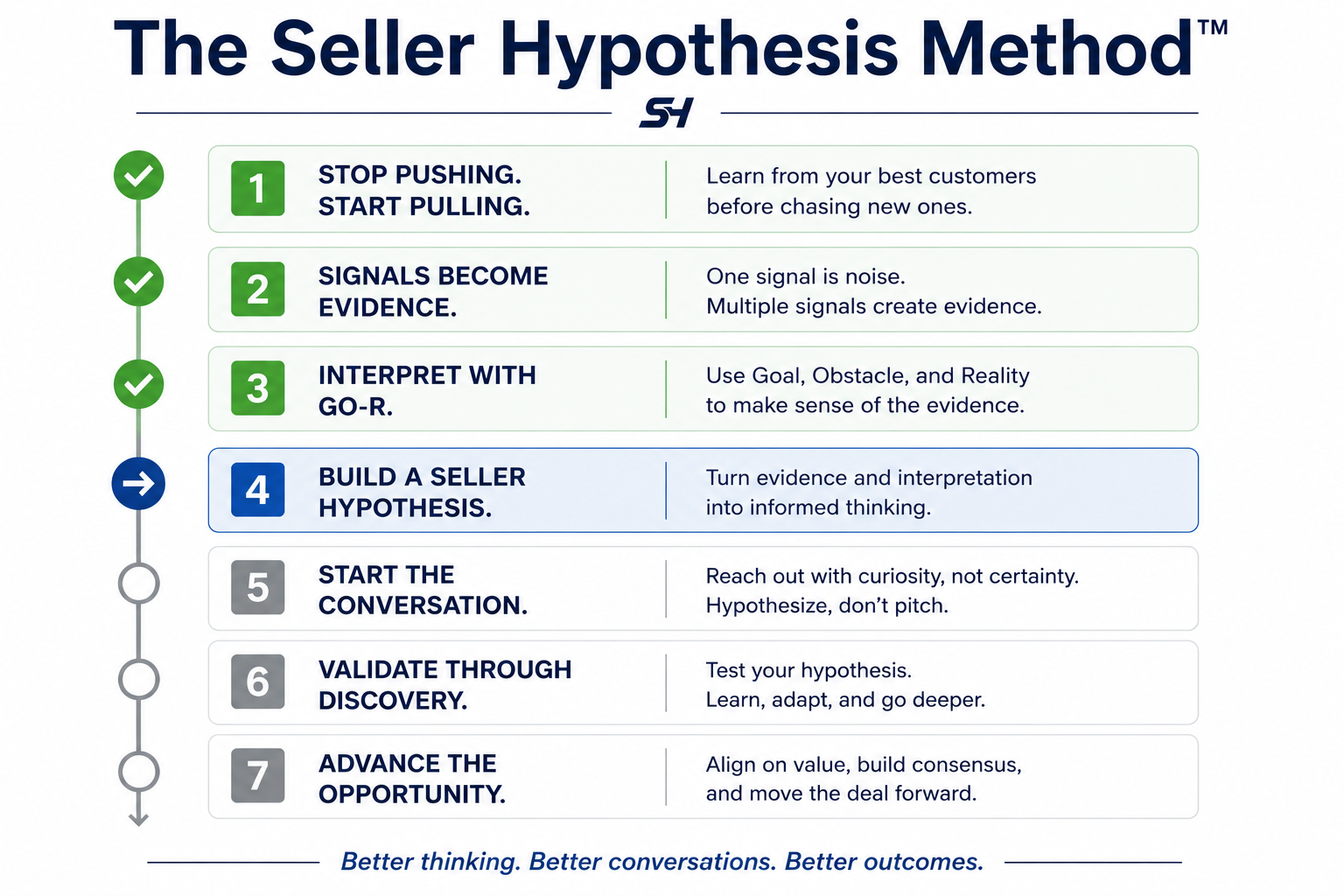
This is where the Seller Hypothesis Method fits. It gives us a disciplined way to move from scattered information to an informed perspective, then into a conversation where that perspective can be tested. The method isn't designed to tell us we're always right. It's designed to help us become more intelligent about the buyer's business as we move through the process. For the full walk-through, see Building a Seller Hypothesis.
A hypothesis is a starting point, not a script. It gives your seller something thoughtful to bring to the conversation instead of asking a prospect to explain everything. If it's wrong, nobody has failed. You've learned something, and that correction is worth more than anything you knew before you picked up the phone.
I think too many sellers approach discovery as though the goal is to get the buyer to confirm what they already believe. It isn't. The goal is an honest discussion about what the buyer is trying to accomplish, what might be getting in the way, and whether there's a meaningful reason to keep talking.

Think of selling as a production line
Selling works much the same way as that plant. Your raw materials are the account data, buyer intelligence, industry knowledge, relationship history, competitive context, and signals you've collected.
Your process is how you interpret those inputs, develop a hypothesis, decide who to engage, conduct the conversation, and determine what you've learned. The output is a better decision about the opportunity and the next action to take.
Sometimes the result is a new project or an ongoing customer relationship. Sometimes it's a lost opportunity or a decision not to pursue an account, and that's not necessarily a failure of the system. If you learn early that a company doesn't have a meaningful problem you can solve, or isn't willing to make a change, you've avoided spending time and resources on a deal that may never have been real.
There's one more part of the analogy that matters. A plant doesn't run one item through the line, produce one finished product, and call the operation complete.
A sales organization needs a reliable flow as well: relevant accounts, new signals, informed hypotheses, conversations, learning, and opportunities. Let's design a process that works repeatedly, not celebrate one good conversation and hope the next one happens by accident.
Why effective selling has to come before efficiency
This brings us to something I've said often: efficient is not the same as effective. Efficiency is about the time and effort it takes to complete a task. Effectiveness is about whether that task actually moves us toward the result we're trying to achieve. In sales, the objective isn't to get through the greatest number of activities. It's to make progress with the right buyers and the right opportunities.
Picture a team that doubles its meetings with an automated outreach sequence, but most of those meetings go to poorly chosen accounts with generic messages and no reason to buy. That's efficient. It's also busywork, and we've just made it easier to do the wrong thing more often. As I wrote last time, AI can speed up a bad process just as easily as a good one.
I'd much rather do the right thing well, even if it takes a little longer, than do the wrong thing at impressive speed. Once we know which activities actually work, then we can ask how to perform them with less waste. If 15 additional minutes of preparation materially improves the quality of a meeting, that's a good investment. If a seller spends an hour collecting information that a well-designed system could assemble in minutes, that's work we should remove.
The question isn't simply how fast we can do something. The question is whether it deserves to be done in the first place. Manufacturers understand this. A process that produces defects faster is not an improvement, and neither is a sales process that creates more meetings with people who have no reason to buy. (A great book to punctuate this concept is The Science of Scaling: Grow Your Business Bigger and Faster Than You Think Possible by Dr. Benjamin Hardy and Blake Erickson, Hay House Business, 2025.)
Build your selling system in the right order
If you're going to put this into practice, the sequence matters.
Figure out the data structure. Decide what information you need about your ideal customers, buyer personas, competitive environment, business challenges, and buying signals. Be clear about where it comes from, where it lives, and how it stays current. Without that foundation, your sellers rebuild the same understanding from scratch for every account.
Define the selling process and how that information feeds it. How do you recognize a company that deserves attention? How do you interpret a signal and develop a hypothesis? How do you prepare questions that are relevant to a particular buyer, test your assumptions, capture what you learn, and decide the next step?
Once you know the process is effective, look for the steps technology can make easier. Let AI help monitor changes, surface useful research, and locate supporting content, and let the CRM retain the history. Keep the seller responsible for the judgment, curiosity, and relationship-building that make the process valuable.
Step two is the operating discipline that turns information into intelligence. It's also how the Seller Hypothesis Method becomes something a seller actually uses rather than another concept discussed in a training session.
Your job as the leader: coach the process, keep the rhythm
Once a process works, it still needs attention. Buyers change, markets change, and the information available to us changes. What made sense six months ago may not be the best way to prepare for a conversation today.
Maybe your team has a sequence of steps for researching an account and developing a hypothesis. Over time, you notice that the most productive conversations tend to begin with a certain kind of business change rather than a particular job title. That's worth investigating, and if one part of the process works better done differently, change it. The purpose of an operating system is to create consistency in what works, not to preserve steps because somebody wrote them down.
That's the leader's job, and it doesn't take a big overhaul. I'd suggest a short monthly review: which conversations went somewhere, what hypothesis or signal started them, and which steps nobody would miss. Rhythm beats intensity. Then coach to the process, not just the results. In pipeline conversations, ask to hear the hypothesis behind a call and what the seller learned from it.
This is also where the 80/20 principle helps. In many businesses, a small number of activities produce a disproportionate share of the value. Which ones actually move deals forward?
Recognizing the right business situation, getting access to the person accountable for the outcome, asking a question that reveals the cost of doing nothing, and helping the buyer understand the implications of a decision. Those deserve your attention, and the repetitive work around them may be a good candidate for automation.
I don't want sellers spending their best hours copying account information, hunting for a case study, or assembling notes that already exist somewhere in the business. Let the system do as much of that as it reasonably can. Technology should support the core of the process, not become a substitute for it.
To tell whether your effective selling process is working, I'd watch three things:
How long it takes a seller to prepare for a call
How many priority conversations started from a written hypothesis
Which activities show up in the deals that moved forward
Start with effective selling, then automate
So don't start by asking which new AI tool to buy or how many more activities your team can complete. Start by getting the right information organized, building a process that turns it into meaningful conversations, and improving that process until it works consistently. Then automate the pieces that make the greatest difference.
Every conversation gives you new information, and every corrected assumption improves your understanding of the buyer. If you capture that learning, your next hypothesis can be better than your last one. That's how fragmented information becomes a real selling system, and how effective selling improves sales acumen rather than simply increasing activity.
If you'd like to talk through what this could look like for your team, let's talk.