

It's Friday afternoon.
You made the calls. You sat in six meetings. You sent thirty emails, updated the CRM, answered a pricing question for operations, and stayed late on Tuesday to finish a proposal. You're tired. You earned it.
Then someone asks the question that good sales pipeline management asks every week: which deal moved forward this week? And the honest answer is none of them.
That's the trap. Sales can become a magnificent hiding place for busywork. A full calendar feels like progress, and it can keep feeling like progress for weeks before the numbers tell you otherwise.
Is being busy the same as building a pipeline?
No. Busy isn't a pipeline stage.
Activity is what you do. Progress is what the buyer does. A deal moves when a buyer takes an action: agrees to a next meeting, brings in another decision maker, shares the information you need, or commits to a decision date.
If the buyer did nothing new this week, the deal didn't move, no matter how much you did around it.
The same goes for conversations. A conversation about sports, weather, or family isn't a meaningful sales conversation. Rapport matters, but it's the on-ramp, not the destination. Don't be a professional greeter.
Where did the week actually go?
Most sellers I coach aren't lazy. They're buried. When we look at a week together, the time usually splits into two kinds of work.
The first is maintenance work: internal meetings, reports, quotes, admin, and chasing deals that haven't moved in a month. The second is revenue work: starting new buyer conversations and advancing qualified deals with a real buyer commitment.
Maintenance work isn't bad. Some of it has to happen. The problem is that it fills every open hour if you let it, and it always feels urgent. Revenue work rarely does.
A full calendar can still produce an empty month.
What happens when you finally look at the pipeline?
One of the first things I do with a new client is clean up the CRM. We don't set baselines against bad data.
One client had more than 100 deals in the active pipeline. On paper, that looked healthy. In practice, nobody could say which of those deals would close.
We took the top 20 and reviewed them in detail in a single session. For each one, we asked three questions. What's the actual next step? What evidence proves that step is accurate? Is the close date realistic?
What we found was hard to hear. Nearly all of those deals had no business being past Discovery. Many were cold. Some were aspirational, deals the team hoped for rather than deals the buyer was working on.
It took a week of data work to get through the full pipeline. That time paid off. We found 9 deals out of more than 100 that were qualified and ready to close. We won most of them.
Just as important, the rest of the pipeline was now in an actionable state. The team began qualifying deals in or out, one at a time, using a system. That freed them to work separately on the things that fill the funnel: value proposition, networking, win-back strategies, and new conversations.
It wasn't easy. But the team got the results they needed, and now they can repeat that system of selling. That team was busy the whole time. Busy is exactly what hid the problem.
What should sales pipeline management cover every Friday?
You don't need a consultant to catch this early. You need fifteen minutes on Friday and two simple, honest questions.
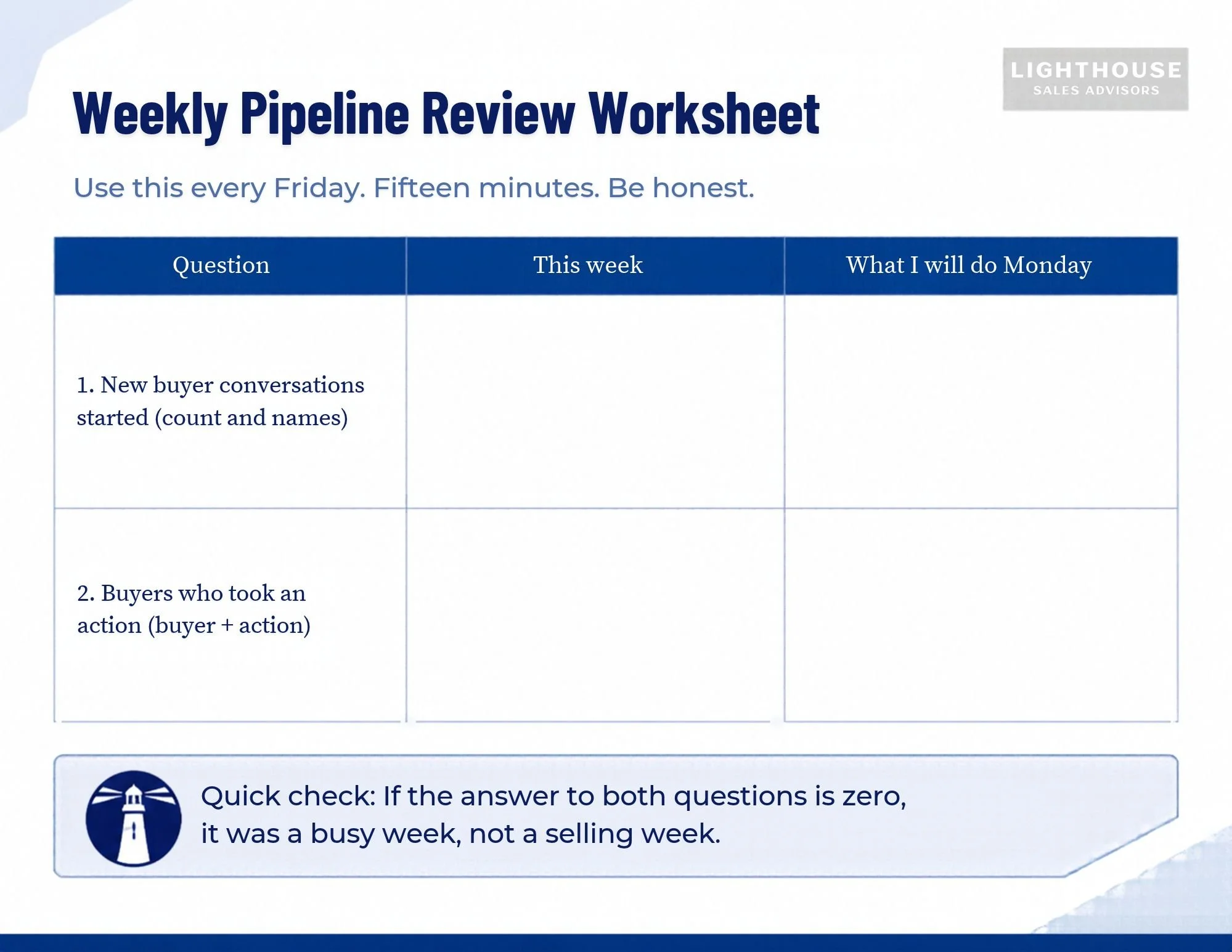
The first is: how many new buyer conversations did I start this week? Not touches. Conversations. New deal creation is the outcome of this question.
The second is: which buyers took an action this week? Name the buyer and the action. This tells you what actually moved and what didn't.
The deals that moved are increasing in probability. The ones that didn't are decaying. My CRM calls it "rotting." Pretty gross imagery, but telling. That deal isn't ripening. It's rotting away in its probability of closing.
Is the answer to work longer hours?
No. The cure isn't working longer. It's getting clearer about what creates buyer movement.
More hours on the same mix of work gives you a more tired version of the same pipeline. Control beats hustle. When you can see where the week went, you can decide where next week goes.
Your next step
Look at last week. Pick one activity to stop, shorten, delegate, or automate. Just one. Then use the worksheet below on Friday.
Sales pipeline management doesn't need to be complicated. It needs to be honest, and it needs to happen every week.
If you want help building this habit with other sellers working on the same thing, join B2B Sales Lab.
Weekly Pipeline Review Worksheet
Here's a simple worksheet to keep where you'll see it on Friday. It takes fifteen minutes and shows you what actually moved in your pipeline this week.
Frequently Asked Questions
These are the questions I hear most often when I coach sellers on sales pipeline management.
What's the difference between sales activity and sales progress?
Activity is what the seller does. Progress is what the buyer does: agreeing to a meeting, bringing in a decision maker, sharing information, or committing to a date.
How can a busy seller tell if the pipeline is healthy?
Count new buyer conversations started and buyer actions taken this week. If both are zero, the pipeline didn't move, however full the calendar was.
What should a seller review every Friday?
Two questions: how many new buyer conversations did I start, and which buyers took an action? Fifteen minutes is enough.
Why do old deals hurt a pipeline?
Deals with no buyer action lose probability every week. Leaving them in the pipeline hides how little is actually moving.